Webプログラミング教育の未来:アジャイル手法とAI支援学習の統合フレームワーク
📌 この記事の結論
- 現代のWebプログラミング教育は、学術的アプローチと実際のソフトウェア開発現場の間に大きな隔たりがある
- このギャップを埋めるため、アジャイル手法とAI支援学習、そして継続的評価を統合した新しい教育フレームワークが必要である
- フレームワークは、AIへの過度な依存を防ぎつつ、神経多様性や多言語学習者を含む多様な学生へのアクセシビリティを確保する戦略を提供する
- この理論的なフレームワークは、将来の経験的検証を必要とし、具体的な実装ガイドラインを提供する
1. はじめに:現代Webプログラミング教育の課題
現代のWebプログラミング教育は、学術的な指導法と実際のソフトウェア開発現場の間に根本的な不一致を抱えています。伝統的なコンピュータサイエンスのカリキュラムは、知識の順序的な伝達と個人のパフォーマンス評価に重点を置いていますが、今日の業界では協調的で反復的なワークフローが求められています。
このギャップは、新卒者の労働力準備不足という形で現れています。最近の調査では、テクノロジー企業の67%が新卒のコンピュータサイエンス卒業生が協調的な開発環境に不十分な準備しかできていないと評価し、73%がアジャイル手法の実践的な応用における具体的な欠点を指摘しています。これは、時代遅れの技術コンテンツ、システムレベルの思考よりも孤立したプログラミングスキルを重視する傾向、そして構築主義的学習理論よりも客観主義的学習理論に根ざした教育モデルといった、より深い構造的な問題を反映しています。
さらに、ChatGPTやGitHub Copilotのような生成型AI技術の出現は、これらの教育的課題を激化させると同時に、潜在的な解決策も提示しています。学生はAIツールを使って構文的に正しいコードを生成できるようになったため、伝統的な評価方法が時代遅れになり、「評価の妥当性の危機」が生じています。AIが最小限の人間の介入で従来のプログラミング課題を完了できるため、AIが強化された環境におけるプログラミング能力とは何かを根本的に再概念化する必要があります。
本論文では、これらの課題に対し、Webプログラミング教育に特化したアジャイルソフトウェア開発の原則とAI支援学習アプローチを体系的に統合するフレームワークを提示しています。このフレームワークは、構築主義的学習理論に基づき、専門的な実践を反映した協調的なプロジェクトを通じて知識を構築し、初心者の開発者に適切な教育的足場(スキャフォールディング)を維持することを目指しています。
2. 紹介する論文の概要
📄 論文情報
| タイトル | Integrating agile methodologies and AI-assisted learning in web programming education: a theoretical framework for CS curriculum transformation (アジャイル手法とAI支援学習を統合したWebプログラミング教育:CSカリキュラム変革のための理論的フレームワーク) |
|---|---|
| 著者 | Pavlo V. Zahorodko and Serhiy O. Semerikov |
| 掲載誌 | Discover Education (2026) 5:166 |
| 研究対象 | Webプログラミング教育におけるアジャイル手法とAI支援学習の統合 |
| 研究期間 | 2015年1月〜2024年12月(文献検索期間) |
研究の目的
現代のWebプログラミング教育における学術的指導法と現代のソフトウェア開発現場の現実との間の根本的な不一致を解消するために、アジャイル手法とAIツールを統合した概念的フレームワークを提案すること。
研究の方法
本研究は、デザインサイエンスリサーチ (DSR) アプローチとテーマ別統合 (Thematic Synthesis) を組み合わせることで、Webプログラミング教育におけるアジャイル手法とAI支援学習を統合するための概念的フレームワークを開発しました。
- **問題特定と目的定義**: 現代のWebプログラミング教育における課題(業界とのギャップ、AIの登場)を特定し、その解決策としてのフレームワークの必要性を定義しました。
- **体系的な文献検索**: Scopus, Web of Science, ACM Digital Library, IEEE Xplore, Google Scholarの5つのデータベースを使用し、2015年1月から2024年12月までの期間を対象に文献を検索しました。検索キーワードは「アジャイル教育」、「AI教育」、「評価」の3つのドメインにわたります。
- **フレームワークの設計と開発**: 検索で得られた2,847件の記録から、重複除去と関連性スクリーニングを経て、最終的に127件の論文を分析対象としました。これらの論文に基づき、構築主義的学習理論、CSCL原則、認知負荷理論に裏付けられたフレームワークの構成要素を設計しました。
- **テーマ別統合によるフレームワーク導出**: 以下の3段階の分析プロセスを通じて、フレームワークの概念を生成しました。
- **行ごとのコーディング**: 127件の論文から、スプリント構造、AIスキャフォールディングメカニズム、評価ポイント、協調的ダイナミクス、実装課題などに関する概念を特定しました。
- **記述的テーマ**: コードを18のカテゴリーにグループ化し、構築主義、CSCL、認知負荷の理論的基盤と関連付けました。
- **分析的テーマ**: 個々の研究を超えた新しい解釈的構成要素として、3つの柱からなるフレームワークアーキテクチャ、段階的なAI統合モデル、スプリントに合わせた評価プロトコルを導き出しました。
- **理論と設計のマッピング**: フレームワークの各設計決定が、構築主義的学習理論、コンピュータ支援協調学習 (CSCL) 原則、認知負荷理論、発達の最近接領域 (ZPD)、自己調整学習といった理論的基盤にどのように基づいているかを体系的に示しました。
3. 研究結果のポイント3つ
本研究によって導き出されたフレームワークは、Webプログラミング教育を変革するための3つの主要な柱に基づいています。これらは、現代のソフトウェア開発の現実に対応し、学習効果を最大化するために設計されています。
✅ ポイント1:反復的な学習サイクル(14日間スプリント)
このフレームワークの核となるのは、Scrum(スクラム)開発の手法を教育用に調整した14日間のスプリントサイクルです。従来の学期単位のプロジェクトでは、学生は提出期限後にしか十分なフィードバックを得られませんでしたが、14日間スプリントは迅速なフィードバックの組み込みと継続的なスキル向上を可能にします。
実証研究では、2週間のスプリントが3週間のスプリントよりも30%高い開発速度を示し、また、教育現場での大規模な実装でも同様の結果が確認されています。これにより、学生はより短期間で成果を出し、その都度改善を重ねることで、深い理解と実践的なスキルを効率的に習得できます。
✅ ポイント2:AIを活用した段階的なスキャフォールディング(3段階支援)
本フレームワークでは、AIを単なる自動化ツールではなく、協調的な学習パートナーとして位置付けています。AI支援は、学習者の習熟度に応じて段階的に減少する「3段階スキャフォールディングモデル」を通じて提供されます。
- **フェーズ1:探索(スプリント1-4日目)**: 学生はChatGPTやCopilotなどのAIツールを制限なく使用し、ツールの能力を探索し、現在の独立した能力を超えるような野心的な問題に取り組むことができます。
- **フェーズ2:ガイド付き練習(スプリント5-10日目)**: AIの利用は制限されます。例えば、AIに相談する前に一定期間は自力で問題に取り組む、AI生成コードを組み込む前に逐一説明を求められる、意図的なエラーを含むAI出力の特定と修正を求められる、といった制約が課されます。
- **フェーズ3:独立した習得(スプリント11-14日目)**: コアとなる成果物についてはAIツールが利用できなくなります。学生はコードレビュー、口頭弁護、ライブでの問題解決を通じて、AIに頼らない自身の能力を実証します。
このアプローチにより、AIへの過度な依存を防ぎながら、プログラミング能力と批判的思考能力を効果的に育成します。
✅ ポイント3:継続的かつ多次元的な評価
このフレームワークでは、高負荷な試験に代わり、スプリントの成果物に合わせた継続的な形成評価を行います。各スプリントでは、機能するコード、ピアレビュー、振り返りといった評価可能な成果物が生成され、これらが総合的に能力開発を実証します。
この評価方法は、伝統的な評価が持つ「測定疲労問題」に対処し、評価を学習プロセスに不可欠なものとして位置付けます。AI支援学習の有効性を測るためには、単にタスク完了度だけでなく、AIへの依存度、概念理解の深さ、転移学習能力といった多次元的な指標を導入することが重要です。これにより、学生がAIを効果的に活用しつつも、自身の基礎的なスキルを確実に発展させているかを正確に把握できます。
4. ADVANCEの現場から見た実感
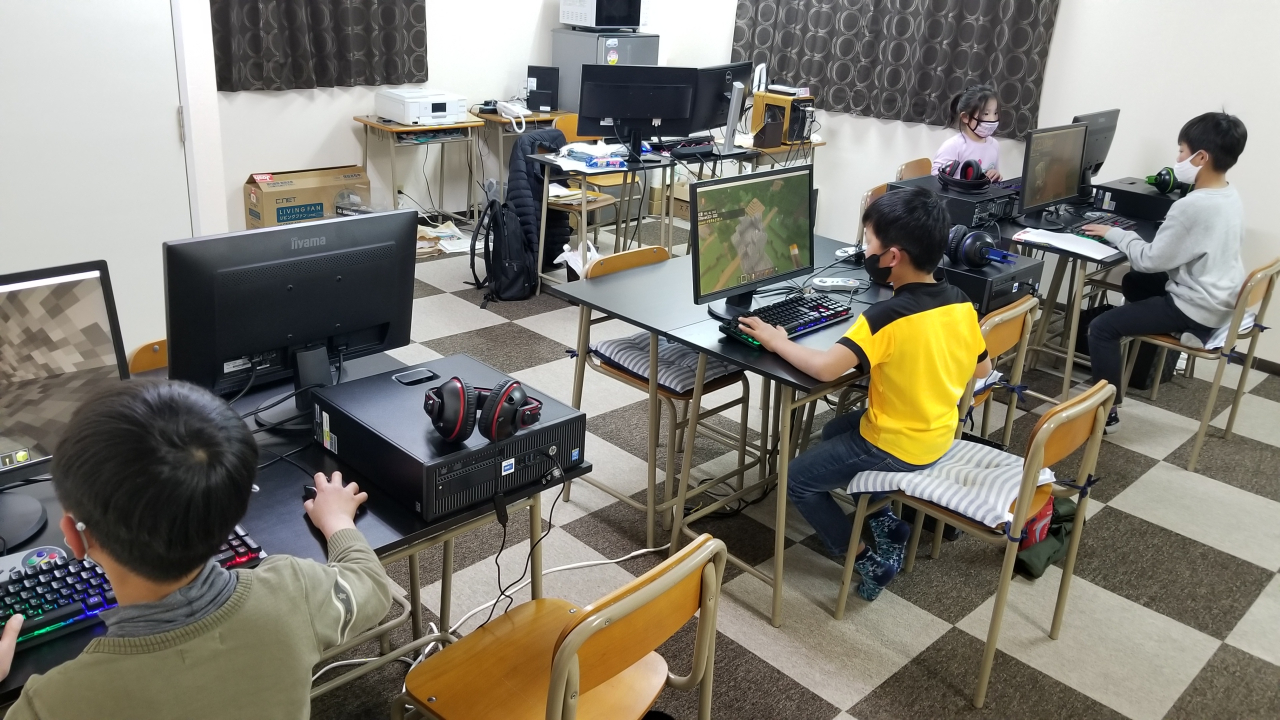
堺市南区のプログラミングスクールADVANCEで実際にプログラミングを教えている講師としての意見は以下の三つです
🎮 現場で感じる3つの変化
実践的な問題解決能力の向上
ADVANCEでは、Scratchや教育版マインクラフトから始まり、Roblox Studio、Unity(C#)、HTML/CSS、JavaScript、Pythonといった多岐にわたるプログラミング言語を用いたゲーム制作やウェブ開発プロジェクトをカリキュラムの核としています。このプロジェクトベースの学習は、論文で述べられているアジャイルの反復的な問題解決プロセスと非常に似ています。生徒たちは、機能するゲームやアプリケーションを作る中で、自ら課題を見つけ、解決策を考案し、実装するという一連のサイクルを経験します。これは、単に知識を吸収するだけでなく、実践を通じて知識を構築する構築主義的学習の良い例であり、座学では得られない深い学びにつながっています。
AIツールの賢い活用と倫理
ChatGPTやGitHub CopilotのようなAIツールが普及する中で、ADVANCEでは生徒にこれらのツールの「賢い使い方」を教えています。例えば、PythonやJavaScriptの課題に取り組む際、AIを補助ツールとして使うことは許可していますが、単にコードを生成させるだけでなく、生成されたコードを理解し、デバッグし、改善するスキルを重視しています。特に、「なぜこのコードで動くのか」「より効率的な書き方はないか」といった批判的な視点を持つよう指導しており、これによりAIへの過度な依存を防ぎ、生徒自身の根本的なプログラミング能力の向上を目指しています。
チームワークとコミュニケーションの重要性
ADVANCEの多くのコース、特にRoblox StudioやUnityを用いたゲーム制作では、グループでのプロジェクトに取り組む機会があります。生徒たちは、アイデアを共有し、役割分担(例えば、Unityでの3Dモデル担当、C#でのスクリプト担当、UIデザイン担当など)を行い、協力して一つの作品を作り上げます。この過程で、日々の進捗報告や振り返りは、お互いの状況を理解し、問題を共有し、解決策を共に考えるためのコミュニケーション能力と協調性を育む上で不可欠です。これは、論文で強調されているCSCL(コンピュータ支援協調学習)の原則と重なる部分であり、現代のソフトウェア開発現場で求められるチームでの協業スキルを早期から身につけることができます。
実践的なプロジェクト、AIの賢い利用、そしてチームでの協業は、現代のプログラミング教育において不可欠な要素であり、ADVANCEではこれらの要素を重視した指導を心がけています。
5. 保護者の方へ:家庭でできること
この論文が示すように、これからのプログラミング教育は、単にコードを書くスキルだけでなく、問題解決能力、AIの適切な活用法、そしてチームで協力する力が求められます。家庭でも、お子様のこれらの能力を育むためにできることがたくさんあります。
「なぜ?」を考え、深く理解する習慣を育む
AIが簡単に答えを出してくれる時代だからこそ、お子様がプログラミングや学習に取り組む際、単に「できた」だけでなく「なぜそのように動くのか?」「なぜこの方法を選んだのか?」と問いかけてみましょう。例えば、Scratchでキャラクターを動かした場合、「どうしてこのブロックの組み合わせで動いたの?」など、原理や意図を考える機会を与えることで、表面的な理解に留まらず、深い概念理解を促すことができます。
小さなプロジェクトを通じて反復的な学習を応援する
学校の課題や習い事とは別に、お子様が興味を持つ小さなプログラミングプロジェクトを応援してみてください。例えば、HTML/CSSで家族の紹介ページを作る、Pythonで簡単な計算ツールを作る、Roblox Studioで友達と遊べるミニゲームを開発するなどです。完成までの期間を短く設定し、何度も試行錯誤する機会を与えることで、アジャイル手法の「反復」と「改善」のプロセスを自然と体験できます。
試行錯誤を「失敗」と捉えず、学びの機会として励ます
プログラミングはエラーと試行錯誤の連続です。お子様がコードでつまずいたり、思った通りに動かなかったりしても、それを「失敗」と捉えずに「次にどうすれば良いか」を教えてくれるヒントだと伝え、解決に向けて一緒に考える姿勢を応援してあげてください。家族で話し合い、協力して問題解決に取り組む経験は、協調性や問題解決能力を育む貴重な機会となります。
🎮 ADVANCEで一緒にプログラミングを始めませんか?
堺市南区のプログラミングスクールADVANCEでは、Scratchからはじめて、Roblox、Unity(C#)まで段階的に学べます。
研究で効果が実証されたプログラミング教育を、ゲーム制作を通じて楽しく体験できます。
▶ ぼうけんを はじめる 無料体験会に申し込む!6. 参考文献
- Kharchenko OY, Semerikov SO. A systematic review of research on teaching web design to secondary school students through HTML and CSS. Discover Education. 2025.
- Rajabi P. Experience Report: Adopting AI-Usage Policy in Software Engineering Education. In: Proceedings of the 26th Western Canadian Conference on Computing Education. WCCCE ’24. New York, NY, USA: Association for Computing Machinery; 2024. p. 19. https://doi.org/10.1145/3660650.3660668.
- Westrick PA, Schmidt FL, Le H, Robbins SB, Radunzel JMR. The road to retention passes through first year academic performance: a meta-analytic path analysis of academic performance and persistence. Educ Assess. 2021;26(1):35–51. https://doi.org/10.1080/10627197.2020.1848423.
- Mikkonen T, Taivalsaari A. Web applications - Spaghetti code for the 21st century. In: Proceedings - 6th ACIS International Conference on Software Engineering Research, Management and Applications, SERA 2008; 2008. p. 319–328. https://doi.org/10.1109/SERA.2008.16.
- Sinha N, Karim R, Gupta M. Simplifying Web Programming. In: Proceedings of the 8th India Software Engineering Conference. ISEC ’15. New York, NY, USA: Association for Computing Machinery; 2015. p. 80–89. https://doi.org/10.1145/2723742.2723750.
- Laun M, Wolff F. Chatbots in education: hype or help? A meta-analysis Learning and Individual Differences. 2025;119:102646. https://doi.org/10.1016/j.lindif.2025.102646.
- Moorhouse BL, Yeo MA, Wan Y. Generative AI tools and assessment: Guidelines of the world’s top-ranking universities. Comput Educ Open. 2023;5:100151. https://doi.org/10.1016/j.caeo.2023.100151.
- Hamaniuk VA, Semerikov SO, Shramko YV. GenAI as scholarly ally: patterns, pedagogy, and policies in graduate writing research. Educ Technol Quarter. 2025;2025(3):234–52. https://doi.org/10.55056/etq.965.
- Cheung ACK, Slavin RE. How methodological features affect effect sizes in education. Educ Res. 2016;45(5):283–92. https://doi.org/10.3102/0013189X16656615.
- Fahd K, Miah SJ, Ahmed K, Miao Y. Integrating design science research and design based research frameworks for developing education support systems. Educ Inf Technol. 2021;26:4027–48. https://doi.org/10.1007/s10639-021-10442-1.
- Thuan NH, Antunes P. Positioning Design Science as an Educational Tool for Innovation and Problem Solving. Communications of the Association for Information Systems. 2022;51(1). https://doi.org/10.17705/1CAIS.05120.
- Thomas J, Harden A. Methods for the thematic synthesis of qualitative research in systematic reviews. BMC Med Res Methodol. 2008;8:45. https://doi.org/10.1186/1471-2288-8-45.
- Castleberry A, Nolen A. Thematic analysis of qualitative research data: Is it as easy as it sounds? Curr Pharm Teach Learn. 2018;10(6):807–15. https://doi.org/10.1016/j.cptl.2018.03.019.
- Eybers S. Design Science Research in Information Systems as Educational Technology in Teaching and Learning Environments: A Systematic Literature Review. In: Innovative Technologies and Learning: 6th International Conference, ICITL 2023, Porto, Portugal, August 28–30, 2023, Proceedings. Berlin, Heidelberg: Springer-Verlag; 2023. p. 385–402. Available from: https://doi.org/10.1007/978-3-031-40113-8_38.
- Peffers K, Tuunanen T, Rothenberger MA, Chatterjee S. A design science research methodology for information systems research. J Manag Inf Syst. 2007;24(3):45–77. https://doi.org/10.2753/MIS0742-1222240302.
- Schad ML, Greene MD, Jones M. A review of theory, theoretical and conceptual frameworks in educational technology. Int J E-Learning. 2021;20(2):187–98. https://doi.org/10.70725/449939rcidku.
- Zackoff MW, Real FJ, Abramson EL, Li STT, Klein MD, Gusic ME. Enhancing educational scholarship through conceptual frameworks: a challenge and roadmap for medical educators. Acad Pediatr. 2019;19(2):135–41. https://doi.org/10.1016/j.acap.2018.08.003.
- Cooperstein SE. Beyond active learning: a constructivist approach to learning. Ref Serv Rev. 2004;32(2):141–8. https://doi.org/10.1108/00907320410537658.
- Popov V, Noroozi O, Barrett JB, Biemans HJA, Teasley SD, Slof B, et al. Perceptions and experiences of, and outcomes for, university students in culturally diversified dyads in a computer-supported collaborative learning environment. Comput Hum Behav. 2014;32:186–200. https://doi.org/10.1016/j.chb.2013.12.008.
- Sweller J, Ayres P, Kalyuga S. Cognitive Load Theory. vol. 1 of Explorations in the Learning Sciences, Instructional Systems and Performance Technologies. New York, NY: Springer; 2011.
- Vygotsky LS. Mind in Society: Development of Higher Psychological Processes. Cambridge, MA: Harvard University Press; 1978. Available from: https://w.pauldowling.me/rtf/2021.1/readings/LSVygotsky_1978_MindinSocietyDevelopmentofHigherPsycholo.pdf.
- Zimmerman BJ. Becoming a self-regulated learner: an overview. Theory Into Pract. 2002;41(2):64–70. https://doi.org/10.1207/s15430421tip4102_2.
- Liu Y, Lin F, Wang X. Using agents in web-based constructivist collaborative learning system. Tsinghua Sci Technol. 2004;9(2):189–96.
- Lu OHT, Huang AYQ, Huang JCH, Huang CSJ, Yang SJH. Early-Stage Engagement: Applying Big Data Analytics on Collaborative Learning Environment for Measuring Learners’ Engagement Rate. In: Proceedings - 5th International Conference on Educational Innovation through Technology, EITT 2016; 2017. p. 106–110. https://doi.org/10.1109/EITT.2016.28.
- Stender P, Krosanke N, Kaiser G. Scaffolding Complex Modelling Processes: An In-Depth Study. In: Stillman GA, Blum W, Kaiser G, editors. Mathematical Modelling and Applications: Crossing and Researching Boundaries in Mathematics Education. International Perspectives on the Teaching and Learning of Mathematical Modelling. Cham: Springer International Publishing; 2017. p. 467–477. https://doi.org/10.1007/978-3-319-62968-1_39.
- Olaussen BS, Bråten I. Students’ use of strategies for self-regulated learning: cross-cultural perspectives. Scand J Educ Res. 1999;43(4):409–32. https://doi.org/10.1080/0031383990430405.
- Davis J, Lachney M, Zatz Z, Babbitt W, Eglash R. A Cultural Computing Curriculum. In: Proceedings of the 50th ACM Technical Symposium on Computer Science Education. SIGCSE ’19. New York, NY, USA: Association for Computing Machinery; 2019. p. 1171–1175. https://doi.org/10.1145/3287324.3287439.
- Corbucci H, Goldman A, Katayama E, Kon F, Melo C, Santos V. Genesis and evolution of the agile movement in Brazil - Perspective from academia and industry. In: Proceedings - 25th Brazilian Symposium on Software Engineering, SBES 2011; 2011. p. 98–107. https://doi.org/10.1109/SBES.2011.26.
- Niculescu V, Suciu D, Bufnea D. Agile principles applied in learning contexts. In: Proceedings of the 3rd International Workshop on Education through Advanced Software Engineering and Artificial Intelligence. EASEAI 2021. New York, NY, USA: Association for Computing Machinery; 2021. p. 31–38. https://doi.org/10.1145/3472673.3473963.
- Canales-Ronda P, Aragonés-Jericó C. Agile methodologies in times of pandemic: acquisition of employment skills in higher education. Educ Train. 2022;64(6):811–25. https://doi.org/10.1108/ET-12-2021-0445.
- Sadullayev I. The role of innovative methodologies in the implementing the electronic educational system: Agile, Scrum, and eduScrum. AIP Conf Proc. 2025;3268(1):060023. https://doi.org/10.1063/5.0257195.
- Sajja R, Sermet Y, Cwiertny D, Demir I. Platform-independent and curriculum-oriented intelligent assistant for higher education. Int J Educ Technol High Educ. 2023;20(1):42. https://doi.org/10.1186/s41239-023-00412-7.
- Ilieva G, Yankova T, Klisarova-Belcheva S, Dimitrov S, Bratkov K, Angelov A. Effects of Generative Chatbots in Higher Education. Information. 2023;14(9):492. https://doi.org/10.3390/info14090492.
- Nathaniel J, Oyelere SS, Suhonen J, Tedre M. Investigating the impact of generative AI integration on the sustenance of higher-order thinking skills and understanding of programming logic. Comput Educ Artif Intell. 2025;9:100460. https://doi.org/10.1016/j.caeai.2025.100460.
- Zarb M, Brown JNA, Goodfellow M, Liaskos K, Young T. Ethical Implications of Gen-AI and LLMs in Computing Education. In: Proceedings of the 2024 on ACM Virtual Global Computing Education Conference V. 2. SIGCSE Virtual 2024. New York, NY, USA: Association for Computing Machinery; 2024. p. 293–294. https://doi.org/10.1145/3649409.3691074.
- Schochet PZ. Statistical power for random assignment evaluations of education programs. J Educ Behav Stat. 2008;33(1):62–87. https://doi.org/10.3102/1076998607302714.
- Fernandez TM, Martin KM, Mangum RT, Bell-Huff CL. Whose Grade is it Anyway?: Transitioning Engineering Courses to an Evidence-based Specifications Grading System. In: 2020 ASEE Virtual Annual Conference Content Access. 10.18260/1-2–35512. Virtual On line: ASEE Conferences; 2020. https://peer.asee.org/35512.
- Kazerouni AM. Toward Continuous Assessment of the Programming Process. In: Proceedings of the 2019 ACM Conference on International Computing Education Research. ICER ’19. New York, NY, USA: Association for Computing Machinery; 2019. p. 335–336. https://doi.org/10.1145/3291279.3339429.
- Chen Y, Zhang L, Mao C. Investigating Chinese College Students’ Cognitive Load in a Gamified Foreign Language Class: A Pilot Study. In: Proceedings of the 5th International Conference on Big Data and Education. ICBDE ’22. New York, NY, USA: Association for Computing Machinery; 2022. p. 217–221. https://doi.org/10.1145/3524383.3524447.
- Ma X, Wang J. WIP: Active Learning Through Prompt Engineering and Agentic AI Simulation-A Pilot Project in Computer Networks Education. In: 2024 IEEE Frontiers in Education Conference (FIE); 2024. p. 1–5. https://doi.org/10.1109/FIE61694.2024.10892925.
- Allison J, Alam A, Gassmann L, Nelson G, Zidan K. Fostering the development of computer science graduate employability through agile projects. J Furth High Educ. 2024;48(4):417–35. https://doi.org/10.1080/0309877X.2024.2340642.
- Hao H, Chen W. Research on the application effect of BOPPPS and ChatGPT-based AI-assisted teaching in the machine learning course. Asia-Pacific Educ Res. 2025. https://doi.org/10.1007/s40299-025-01026-5.
- Alrabah A, Alawini A. CodeLens: A Generative AI Framework for Automated Feedback on SQL Assignments. In: Proceedings of the 4th International Workshop on Data Systems Education: Bridging Education Practice with Education Research. DataEd ’25. New York, NY, USA: Association for Computing Machinery; 2025. p. 29–34. https://doi.org/10.1145/3735091.3737534.
- Calsin MA, Aedo M, Castro E. Impact of ChatGPT on Teaching: A Flipped Classroom Approach for Programming Fundamentals [Impacto de ChatGPT en la enseñanza: Un enfoque de aula invertida para fundamentos de programación]. RISTI - Revista Iberica de Sistemas e Tecnologias de Informacao. 2023;2023(52):97–112. https://doi.org/10.17013/risti.52.97-112.
- Zheng L, Zhen Y, Niu J, Zhong L. An exploratory study on fade-in versus fade-out scaffolding for novice programmers in online collaborative programming settings. J Comput High Educ. 2022;34(2):489–516. https://doi.org/10.1007/s12528-021-09307-w.
- Matobobo C, Ncube PDN, Ngesimani NL, Dzvapatsva GP, Chinhamo E. Enhancing Computational Thinking and Problemsolving in Programming Education Through Generative AI: A Scoped Review. In: IEEE Global Engineering Education Conference, EDUCON; 2025. https://doi.org/10.1109/EDUCON62633.2025.11016317.
- Mellado R, Cubillos C. Can generative artificial intelligence outperform self-instructional learning in computer programming?: Impact on Motivation and Knowledge Acquisition. Appl Sci. 2025;15(11):5867. https://doi.org/10.3390/app15115867.
- Kumar S. The Agile Scrum Ceremony Most Talked About but Least Paid Attention To: Efficient and Fun Agile Scrum Retrospective. In: Misra S, Jadeja R, Mittal M, editors. Practical Approaches to Agile Project Management. IGI Global Scientific Publishing; 2024. p. 111–118. Available from: https://doi.org/10.4018/979-8-3693-3318-1.ch006.
- Agbo FJ, Olivia C, Oguibe G, Sanusi IT, Sani G. Computing education using generative artificial intelligence tools: a systematic literature review. Comput Educ Open. 2025;9:100266. https://doi.org/10.1016/j.caeo.2025.100266.
- Samala AD, Rawas S. Triadic fusion: investigating the educational impact of AI, AR, and NLP integration in creating immersive and conversational learning environments. Interactive Learning Environments. 2025;https://doi.org/10.1080/10494820.2025.2554987.
- Tadimalla SY, Maher ML. Sociotechnical AI Education Course Design for CS Majors and Non-Majors. In: Proceedings of the 56th ACM Technical Symposium on Computer Science Education V. 2. SIGCSETS 2025. New York, NY, USA: Association for Computing Machinery; 2025. p. 1631–1632. https://doi.org/10.1145/3641555.3705252.
- Barna OV, Kuzminska OH, Semerikov SO. Enhancing digital competence through STEM-integrated universal design for learning: a pedagogical framework for computer science education in Ukrainian secondary schools. Discov Educ. 2025;4(1):357. https://doi.org/10.1007/s44217-025-00821-y.
- Duah JE, Lu X, McGivern P, Jing Y. Interdisciplinary Perspectives on Generative Artificial Intelligence Adoption in Higher Education: A Theoretical Framework Review. In: Proceedings of the 2024 7th International Conference on Big Data and Education. ICBDE ’24. New York, NY, USA: Association for Computing Machinery; 2025. p. 1–9. Available from: https://doi.org/10.1145/3704289.3704293.
- Beyer J, Yang Y, Pfister H. Visualization design sprints for online and on-campus courses. IEEE Comput Graphics Appl. 2021;41(6):37–47. https://doi.org/10.1109/MCG.2021.3115413.
- Liechti O, Pasquier J, Reis R. Beyond dashboards: On the many facets of metrics and feedback in agile organizations. In: Proceedings - 2017 IEEE/ACM 10th International Workshop on Cooperative and Human Aspects of Software Engineering, CHASE 2017; 2017. p. 16–22. https://doi.org/10.1109/CHASE.2017.5.
- Ferreira VG, Canedo ED. Using design sprint as a facilitator in active learning for students in the requirements engineering course: an experience report. In: Proceedings of the 34th ACM/SIGAPP Symposium on https://doi.org/10.1145/3297280.3297463.
- Nascimento N, Santos A, Sales A, Chanin R. Is There an Optimal Sprint Length on Agile Software Development Projects? In: Proceedings of the 24th International Conference on Enterprise Information Systems - Volume 2: ICEIS. INSTICC. SciTePress; 2022. p. 98–105. https://doi.org/10.5220/0011037700003179.
- Park DS, Noh JY. The Effect of Sprint Duration to the Velocity in a Large-Scale Embedded Software Project. In: 2023 ACM/IEEE International Symposium on Empirical Software Engineering and Measurement (ESEM); 2023. p. 1–5. https://doi.org/10.1109/ESEM56168.2023.10304859.
- Cavrak I, Bucaioni A, Mirandola R. Impact of Key Scrum Role Locations in Student Distributed Software Development Projects. In: 2023 IEEE 35th International Conference on Software Engineering Education and Training (CSEE&T); 2023. p. 69–78. https://doi.org/10.1109/CSEET58097.2023.00018.
- Kumpang P, Chaijaroen S. Designing framework of constructivist web-based learning environment to enhance problem solving. Turkish Online Journal of Educational Technology. 2017;2017(October Special Issue INTE):753–764. https://tinyurl.com/bdhtkp8s.
- Nerur S, Balijepally V. Theoretical reflections on agile development methodologies. Commun ACM. 2007;50(3):79–83. https://doi.org/10.1145/1226736.1226739.
- Kumar J. Psychological ownership towards online brand communities driving brand engagement: a visitors’ perspective. J Strateg Mark. 2022;30(4):355–88. https://doi.org/10.1080/0965254X.2022.2063926.
- Vettraino L, Guglielman E, Guspini M, Castello V. Complex learning: A way for rethinking pedagogies and processes in technology-enhanced learning and education. In: Proceedings of the 12th IEEE International Conference on Advanced Learning Technologies, ICALT 2012; 2012. p. 143–145. https://doi.org/10.1109/ICALT.2012.95.
- Sivasakthi M, Meenakshi A. Generative AI in programming education: evaluating ChatGPT’s effect on computational thinking. SN Comput Sci. 2025;6(5):541. https://doi.org/10.1007/s42979-025-04051-9.
- Šumak B, López-De-Ipiña D, Dziabenko O, Correia SD, De Carvalho LMS, Lopes S, et al. AI-Based Education Tools for Enabling Inclusive Education: Challenges and Benefits. In: 2024 47th ICT and Electronics Convention, MIPRO 2024 - Proceedings; 2024. p. 472–477. https://doi.org/10.1109/MIPRO60963.2024.10569714.
- Feldman-Maggor Y, Cerratto-Pargman T, Viberg O. Seeing the Forest from the Trees: Unveiling the Landscape of Generative AI for Education Through Six Evaluation Dimensions. In: Ferreira Mello R, Rummel N, Jivet I, Pishtari G, Ruipérez Valiente JA, editors. Technology Enhanced Learning for Inclusive and Equitable Quality Education. vol. 15160 of Lecture Notes in Computer Science. Cham: Springer Nature Switzerland; 2024. p. 99–105. Available from: https://doi.org/10.1007/978-3-031-72312-4_12.
- Nanjundappa R, Gajendra N, Lakshya PS, S, Mahesha NM, Pahuja A, AWAF: AI Enabled Web Contents Authoring Framework. In, et al. IEEE 17th India Council International Conference, INDICON 2020; 2020. 2020. https://doi.org/10.1109/INDICON49873.2020.9342385.
- Domenech NV, Villavicencio WR, Giraldo De López M, Carrasquero Ferrer SJ. The ethics in the challenge of implementing AI within the educational field [Ética en el desafío de la implementación de IA dentro del ámbito educativo]. In: Memorias de la Conferencia Iberoamericana de Complejidad, Informatica y Cibernetica, CICIC; 2025. p. 141–149. https://doi.org/10.54808/CICIC2025.01.141.
- Le R. Transformative AI tools for inclusive and holistic learning environments: Enhancing accessibility, equity, and emotional intelligence. In: AI, Personalization, Equity, and the Future of Learning. Hershey, PA: IGI Global Scientific Publishing; 2025. p. 469–492. https://doi.org/10.4018/979-8-3373-5097-4.ch017.
- Aboalela R. Harnessing Technology to Achieve the Highest Quality in the Academic Program of University Studies The Quality Based on ABET and NCAAA Accreditations. Int J Adv Comput Sci Appl. 2024;15(8):279–92. https://doi.org/10.14569/IJACSA.2024.0150829.
- Saradha P, Gomathi RD, Mythili M, Jamuna G, Karthick S, Indhumathi N, et al. Integration of AI tools in learning pedagogy for L2 Learners in Engineering Education: Impacts, Challenges and Possibilities. In: 2024 15th International Conference on Computing Communication and Networking Technologies, ICCCNT 2024; 2024. https://doi.org/10.1109/ICCCNT61001.2024.10726115.
- Fachrurrazy M, Beddu R, Efendi E, Firmansyah F, Jamaluddin F, SIliwadi DN. AI policy framework in education for advancing society 5.0 with safe AI implementation. In: AI, Policy, and the Future of Human-Centered Education. Hershey, PA: IGI Global Scientific Publishing; 2025. p. 165–196. https://doi.org/10.4018/979-8-3373-5781-2.ch007.
- Pavlova Y, Slavov V. Exploring the Ethical Use of AI Technologies/Applications in Academic Environments. In: 60th International Scientific Conference on Information, Communication and Energy Systems and Technologies, ICEST 2025 - Proceedings; 2025. https://doi.org/10.1109/ICEST66328.2025.11098253.
- Alazzawi FJI, Shannaq B, Al Maqbali S, Alrawahi S. The role of predictive analytics for adaptive e-learning: a future pathway framework for personalized education. Studies in Big Data. 2025;171:367–76. https://doi.org/10.1007/978-3-031-83911-5_32.
- Shtayyat A, Gawanmeh A. Enhancing Educational Diversity and Inclusion Through AI-Enabled Adaptive Moodle Architecture. In: 2025 1st International Conference on Computational Intelligence Approaches and Applications, ICCIAA 2025 - Proceedings; 2025. Available from:https://doi.org/10.1109/ICCIAA65327.2025.11013075.
- Blasquez I. Developing Critical Thinking with AI Coding Assistants: An Educational Experience focusing on Testing and Legacy Code. In: Proceedings of the 30th ACM Conference on Innovation and Technology in Computer Science Education V. 1. ITiCSE 2025. New York, NY, USA: Association for Computing Machinery; 2025. p. 500–506. https://doi.org/10.1145/3724363.3729050.
- Le H. The Deskilling of Software Development and the Impact of AI Chatbots on Programmers’ Skills and Roles. In: AguilarCalderón JA, editor. Generative AI in Software Engineering. Hershey, PA: IGI Global Scientific Publishing; 2025. p. 397–426. https://doi.org/10.4018/979-8-3373-0370-3.ch013.
- Din SSU, Aslam MA, Farid S, Khan TF, Abid MK. Enhancing AI system transparency and explainability: integrating formal methodologies for improved model performance and interpretability. Spectr Eng Sci. 2025;3(5):395–410. https://doi.org/10.5281/zenodo.15422586.
- Türkmen G. The review of studies on explainable artificial intelligence in educational research. J Educ Comput Res. 2025;63(2):277–310. https://doi.org/10.1177/07356331241310915.
- Wang FH. Exploring the Impact of Transparent Generative AI on Learning Outcomes Through a Human-Machine Trust Model. In: 2025 IEEE International Conference on Advanced Learning Technologies (ICALT); 2025. p. 229–233. https://doi.org/10.1109/ICALT64023.2025.00072.
- Ayanwale MA. Building Trust in AI-Powered Assessment Through Explainable Machine Learning Models. In: Proceedings of the ACM Global on Computing Education Conference 2025 Vol 2. CompEd 2025. New York, NY, USA: Association for Computing Machinery; 2025. p. 403–404. https://doi.org/10.1145/3736251.3747313.
- Chakraborty M. Explainable Artificial Intelligence (XAI): A Perspective. In: Chakraborty M, Chakrabarty SP, Penteado A, Balas VE, editors. Proceedings of 5th International Ethical Hacking Conference. vol. 1148 of Lecture Notes in Networks and Systems. Singapore: Springer Nature Singapore; 2025. p. 47–63. https://doi.org/10.1007/978-981-97-8457-8_5.
- Dib L, Capus L. Using Local Explainability to Analyze Learner Performance in Education. In: Arai K, editor. Advances in Information and Communication. vol. 1285 of Lecture Notes in Networks and Systems. Cham: Springer Nature Switzerland; 2025. p. 603–620. https://doi.org/10.1007/978-3-031-84460-7_38.
- Ramachandran L, Gehringer EF, Yadav RK. Automated Assessment of the Quality of Peer Reviews using Natural Language Processing Techniques. Int J Artif Intell Educ. 2017;27(3):534–81. https://doi.org/10.1007/s40593-016-0132-x.
- Guardiola MA. Educational Leadership and AI in the Post-COVID-19 Era: Ethical Challenges and Opportunities in Catalonia. In: Hawamdeh MMK, editor. Digital Citizenship and the Future of AI Engagement, Ethics, and Privacy. Hershey, PA: IGI Global Scientific Publishing; 2025. p. 569–601. Available from: https://doi.org/10.4018/979-8-3693-9015-3.ch019.
- Hadyaoui A, Cheniti-Belcadhi L. Open assessment framework for intelligent peer feedback in the project-based collaborative learning environment. SN Comput Sci. 2025;6(6):687. https://doi.org/10.1007/s42979-025-04220-w.
- Lin CJ, Pedaste M, Huang YM. AI-Supported Summative Reflection to Foster Motivation and Teamwork in STEM: An Application of the 6E+R Framework. In: Wang WS, Sandnes FE, Lai CF, Sandtrø TA, Huang YM, editors. Innovative Technologies and Learning. vol. 15913 of Lecture Notes in Computer Science. Cham: Springer Nature Switzerland; 2026. p. 171–180. https://doi.org/10.1007/978-3-031-98185-2_19.
- Juan Nunez MV, Diana Rivera CV, Paz LP, De La Prieta F, Corchado JM. Implementation of the AIScrum-Sprint Methodology for Problem Solving in Small and Medium Enterprises within the Framework of Algorithm and Programming Courses. In: EDUNINE 2024 - 8th IEEE World Engineering Education Conference: Empowering Engineering Education: Breaking Barriers through Research and Innovation, Proceedings; 2024. Available from: https://doi.org/10.1109/EDUNINE60625.2024.10500540.
- Arce E, Suárez-García A, López-Vázquez JA, Fernández-Ibáñez MI. Design sprint: enhancing STEAM and engineering education through agile prototyping and testing ideas. Thinking Skills Creativity. 2022;44:101039. https://doi.org/10.1016/j.tsc.2022.101039.
- Hulshult AR, Krehbiel TC. Using Eight Agile Practices in an Online Course to Improve Student Learning and Team Project Quality. Journal of Higher Education Theory and Practice. 2019;19(3):55–67. https://doi.org/10.33423/jhetp.v19i3.2116.
- Avila DT, Van Petegem W, Snoeck M. Improving Teamwork in Agile Software Engineering Education: The ASEST+ Framework. IEEE Trans Educ. 2022;65(1):18–29. https://doi.org/10.1109/TE.2021.3084095.
- Astorga-Vargas MA, Justo-López AC, Valenzuela GEC, Flores-Rios BL, Vázquez JPG, Ibarra-Esquer JE. Integration of different instructional strategies: ABP, Scrum framework and School environment company in the professional education of IT undergraduates [Integración de diferentes estrategias instruccionales: ABP, Scrum y empresa escolar en la formación profesional de estudiantes de TI]. RISTI - Revista Iberica de Sistemas e Tecnologias de Informacao. 2023;2023(E61):98–112. https://dialnet.unirioja.es/servlet/articulo?codigo=10039950.
- Andriyani Y. Knowledge Management and Reflective Practice in Daily Stand-Up and Retrospective Meetings. In: Baumeister H, Lichter H, Riebisch M, editors. Agile Processes in Software Engineering and Extreme Programming. Cham: Springer International Publishing; 2017. p. 285–291. https://doi.org/10.1007/978-3-319-57633-6_21.
- Hundhausen C, Conrad P, Tariq A, Pugal S, Flores BZ. An Empirical Study of the Content and Quality of Sprint Retrospectives in Undergraduate Team Software Projects. In: Proceedings of the 46th International Conference on Software Engineering: Software Engineering Education and Training. ICSE-SEET ’24. New York, NY, USA: Association for Computing Machinery; 2024. p. 104–114. https://doi.org/10.1145/3639474.3640074.
- Jungclaus J, Korge G, Arndt P, Bauer A. Agile Sprintlearning – a new conceptual framework for learning in digitized work [Agiles Sprintlernen – ein Konzept für dezentrales betriebliches Lernen: Empirische Begründung und praktische Erfahrungen]. Gruppe Interaktion Organisation Zeitschrift fur Angewandte Organisationspsychologie. 2019;50(2):217–27. https://doi.org/10.1007/s11612-019-00468-y.
- Bogdanova M, Parashkevova-Velikova E. Agile perspectives in higher education. Smart Innov Syst Technol. 2022;276:333–45. https://doi.org/10.1007/978-981-16-8866-9_28.
- Israel M, Jeong G, Ray M, Lash T. Teaching Elementary Computer Science through Universal Design for Learning. In: Proceedings of the 51st ACM Technical Symposium on Computer Science Education. SIGCSE ’20. New York, NY, USA: Association for Computing Machinery; 2020. p. 1220–1226. Available from:https://doi.org/10.1145/3328778.3366823.
- Jacob S, Montoya J, Prado Y, Coenraad M, Burke W, Warschauer M. Designing for All: Universal Design for Learning Meets Computational Thinking for Multilingual Students. In: Proceedings of the 2025 Conference on Research on Equitable and Sustained Participation in Engineering, Computing, and Technology. RESPECT 2025. New York, NY, USA: Association for Computing Machinery; 2025. p. 309–316. Available from: https://doi.org/10.1145/3704637.3734766.
- Juvino De Araújo EC, Andrade WL, Souto Oliveira AL. Perceptions about Teaching Programming in the Neurodiverse Students’ Context. In: 2024 IEEE Frontiers in Education Conference (FIE); 2024. p. 1–9. Available from: https://doi.org/10.1109/FIE61694.2024.10892904.
- Beaux H, Karimi P, Pop O, Clark R. Guiding Empowerment Model: Liberating Neurodiversity in Online Higher Education. In: 2024 IEEE Frontiers in Education Conference (FIE); 2024. p. 1–9. Available from: https://doi.org/10.1109/FIE61694.2024.10893125.
- Asbell-Clarke J, Robillard T, Edwards T, Bardar E, Weintrop D, Grover S, et al. Including Neurodiversity in Foundational and Applied Computational Thinking (INFACT). In: Proceedings of the 53rd ACM Technical Symposium on Computer Science Education V. 2. SIGCSE 2022. New York, NY, USA: Association for Computing Machinery; 2022. p. 1076. Available from: https://doi.org/10.1145/3478432.3499044.
- Patilima H. Neurodiversity and trauma in early childhood: implications for inclusive learning. South Afr J Childhood Educ. 2025;15(1):a1704. https://doi.org/10.4102/sajce.v15i1.1704.
- Pozos RK, Severance S, Denner J, Tellez K. Exploring design principles in computational thinking instruction for multilingual learners. Teach Coll Rec. 2022;124(5):127–45. https://doi.org/10.1177/01614681221104043.
- Sanderson NC, Kessel S, Chen W. What do faculty members know about universal design and digital accessibility? A qualitative study in computer science and engineering disciplines. Univ Access Inf Soc. 2022;21(2):351–65. https://doi.org/10.1007/s10209-022-00875-x.
- Baghban Karimi O, Gao A, Lindner P, Toti G, Engineer R, Hur J, et al. Exploring Equity, Diversity, and Inclusion in Computer Science Undergraduate Curricula. In: Proceedings of the 2024 on Innovation and Technology in Computer Science Education V. 2. ITiCSE 2024. New York, NY, USA: Association for Computing Machinery; 2024. p. 765–766. Available from: https://doi.org/10.1145/3649405.3659531.
- Bai X, Li M, Pei D, Li S, Ye D. Continuous delivery of personalized assessment and feedback in agile software engineering projects. In: Proceedings of the 40th International Conference on Software Engineering: Software Engineering Education and Training. ICSE-SEET ’18. New York, NY, USA: Association for Computing Machinery; 2018. p. 58–67. Available from: https://doi.org/10.1145/3183377.3183387.
- Alshammari MT. An investigation into ChatGPT-enhanced adaptive e-learning systems. TEM J. 2025;14(1):503–10. https://doi.org/10.18421/TEM141-45.
- Hodgkinson BF, Whittenburg NE. WIP: AI-based Sentiment Analysis and Grader Enhancements. In: 2024 ASEE Annual Conference & Exposition. 10.18260/1-2–48287. Portland, Oregon: ASEE Conferences; 2024. https://peer.asee.org/48287.
- Chun AHW. The Agile Teaching/Learning Methodology and Its e-Learning Platform. In: Liu W, Shi Y, Li Q, editors. Advances in Web-Based Learning – ICWL 2004. vol. 3143 of Lecture Notes in Computer Science. Berlin, Heidelberg: Springer Berlin Heidelberg; 2004. p. 11–18. https://doi.org/10.1007/978-3-540-27859-7_2.
- Mahnic V, Hovelja T. Teaching user stories within the scope of a software engineering capstone course: Analysis of students’ opinions. Int J Eng Educ. 2014;30(4):901–15 (https://dialnet.unirioja.es/servlet/articulo?codigo=7360943.).
- Groothuijsen S, van den Beemt A, Remmers JC, van Meeuwen LW. AI chatbots in programming education: Students’ use in a scientific computing course and consequences for learning. Comput Educ Artif Intell. 2024;7:100290. https://doi.org/10.1016/j.caeai.2024.100290.
- Santos MFd. Reestruturação pedagógica de gestão de projeto de software [Master’s thesis]. Instituto Superior de Engenharia de Coimbra (ISEC), Instituto Politécnico de Coimbra. Coimbra, Portugal; 2024. Available from: http://hdl.handle.net/10400.26/57556.
- Figueiredo J, García-Peñalvo F. Teaching and Learning Strategies for Introductory Programming in University Courses. In: Ninth International Conference on Technological Ecosystems for Enhancing Multiculturality (TEEM’21). TEEM’21. New York, NY, USA: Association for Computing Machinery; 2021. p. 746–751. https://doi.org/10.1145/3486011.3486540.
- Pires Ja, Gomes A, Borges AR, Correia FB. Predicting Higher Education Student’s Aptitude to Learn to Program: A Systematic Literature Review. In: Proceedings of the International Conference on Computer Systems and Technologies 2024. CompSysTech ’24. New York, NY, USA: Association for Computing Machinery; 2024. p. 242–248. https://doi.org/10.1145/3674912.3674949.
- Allison J, Alam A, Gassmann L, Nelson G, Zidan K. Fostering the development of computer science graduate employability through agile projects. J Furth High Educ. 2024;48(4):417–35. https://doi.org/10.1080/0309877X.2024.2340642.
- Abouelenein YAM, Ghazala AFA, Mahdy EMM, Khalaf MHR. The R5E pattern: can artificial intelligence enhance programming skills development? Educ Inf Technol. 2025. https://doi.org/10.1007/s10639-025-13616-3.
- Thong CL, Atallah Z, Islam S, Lim W, Cherukuri AK. AI-powered Tools for Doctoral Supervision in Higher Education: A Systematic Review. J Inf Knowl Manag. 2025;24(2):2530001. https://doi.org/10.1142/S0219649225300013.
- Katipoglu G, Utku S, Mijailovic I, Mekic E, Avdic D, Milic P. Action Research Approach to Analysis of Teaching of Blockchain Web 3.0 Application Based on MACH Architecture. Applied Sciences. 2024;14(23):11158. https://doi.org/10.3390/app142311158.
- Zorzo SD, de Ponte L, Lucrédio D. Using Scrum to teach software engineering: A case study. In: 2013 IEEE Frontiers in Education Conference (FIE); 2013. p. 455–461. Available from: https://doi.org/10.1109/FIE.2013.6684866.
- Pombo N, Cunha C. Agile Methodologies in Education: The Common Ground of Personalized Learning and Project-Based Learning. In: Song YT, Kang M, Rhee J, editors. 2025 IEEE/ACIS 23rd International Conference on Software Engineering Research, Management and Applications, SERA 2025 - Proceedings. Institute of Electrical and Electronics Engineers Inc.; 2025. p. 89–96. Available from: https://doi.org/10.1109/SERA65747.2025.11154615.
- Almeida D, de Souza MC, da Silva BP, Paes RL, Soliman M, Costa SB, et al. Agile Methodologies in the Educational Context: A Systematic Literature Review. In: Mesquita D, Villas-Boas V, Lima RM, editors. International Symposium on Project Approaches in Engineering Education. vol. 15. University of Minho; 2025. p. 351–358. Available from: https://doi.org/10.5281/zenodo.15878750.
- Geetha LS, Baker El-Ebiary YA, Rao BS, Rautrao RR, Rao TSM, Ramesh JVN, et al. Challenges and Solutions in Agile Software Development: A Managerial Perspective on Implementation Practices. Int J Adv Comput Sci Appl. 2025;16(3):748–58. https://doi.org/10.14569/IJACSA.2025.0160374.
- Zapater M, Malagón P, De Goyeneche JM, Moya JM. Project-Based Learning and Agile Methodologies in Electronic Courses: Effect of Student Population and Open Issues. Electronics. 2013;17(2):82–8. https://doi.org/10.7251/ELS1317082Z.
- Abdulrachman LM, Llantos OE. Asynchronous Inter-Class Project Collaboration Adaptation Method to Agile Practices in University Context. Procedia Computer Science. 2024;251:57–65. https://doi.org/10.1016/j.procs.2024.11.084.
- Bhuttah TM, Xusheng Q, Abid MN, Sharma S. Enhancing student critical thinking and learning outcomes through innovative pedagogical approaches in higher education: the mediating role of inclusive leadership. Sci Rep. 2024;14(1):24362. https://doi.org/10.1038/s41598-024-75379-0.
- Klochko OV, Gurevych RS, Fedorets VM, Klochko VI, Konoshevskyi OL, Kovtoniuk MM. System-forming aspects of computer science and mathematics teachers’ readiness to develop and use computer didactic games: a comprehensive TPACKGPCK framework analysis. In: Semerikov SO, Striuk AM, Pinchuk OP, Vakaliuk TA, editors. Proceedings of the 8th International Workshop on Augmented Reality in Education (AREdu 2025) co-located with 6th International Conference on History, Theory and Methodology of Learning (ICHTML 2025), Kryvyi Rih, Ukraine, May 13, 2025. vol. 4060 of CEUR Workshop Proceedings. CEUR-WS.org; 2025. p. 332–367. Available from: https://ceur-ws.org/Vol-4060/paper14.pdf.
- Balawi S, Khalaf K, Hitt GW. Leveraging Pedagogical Innovations for Science, Technology, Engineering, and Mathematics (STEM) Education in the Middle East Context. In: Abdulwahed M, Hasna MO, Froyd JE, editors. Advances in Engineering Education in the Middle East and North Africa: Current Status, and Future Insights. Cham: Springer International Publishing; 2016. p. 59–115. Available from: https://doi.org/10.1007/978-3-319-15323-0_4.
- Paulick J, Quinn AM, Blain CD. Developing culturally responsive teaching self-efficacy through engaged, asset-based teacher preparation. Teach Educ. 2024;35(1):61–81. https://doi.org/10.1080/10476210.2023.2215166.
- Astrachan O, Osborne RB, Lee I, Beth B, Gray J. Diverse learners, diverse courses, diverse projects: learning from challenges in new directions. In: Proceedings of the 45th ACM Technical Symposium on Computer Science Education. SIGCSE ’14. New York, NY, USA: Association for Computing Machinery; 2014. p. 177–178. https://doi.org/10.1145/2538862.2538991.