プログラミング教育における生成系AIツールの利用に関する研究の系統的レビュー
📌 この記事の結論
-
生成系AIはプログラミング教育に多大な可能性をもたらし、特に学生の学習成果、プログラミングスキル、計算的思考、自己効力感を向上させる。
-
最も普及しているAIツールはChatGPTであり、主にPythonを用いた学部生向けの教育で活用されている。
-
過度な依存、盗用、AIの正確性といった課題があるため、教師はガイド付きの利用と倫理的意識の育成が重要である。
1. プログラミング教育における生成系AI:急速な進化と背景
デジタル化が進む現代社会において、教育はあらゆる分野で根本的な変化を遂げています。特にプログラミング教育のような実践的なスキルを習得する分野では、学習者の個別のニーズに合わせた指導の重要性が高まっています。従来の教育手法では、生徒一人ひとりの学習速度やスタイルに合わせた即時フィードバックを提供することが困難であり、これが生徒のストレス、フラストレーション、モチベーションの低下につながることも指摘されていました。
近年、生成系人工知能(Gen-AI)技術の急速な発展は、この課題に対する新たな解決策を提示しています。ChatGPTやGitHub Copilotに代表される大規模言語モデル(LLM)は、自然言語の説明からコードを生成したり、既存のコードのエラーを修正したりする能力を持つため、プログラミング教育に革命的な変化をもたらす可能性を秘めています。これらのAIツールは、学習者がより効率的にプログラミングスキルを習得し、計算的思考力を養う上で強力なサポートを提供することが期待されています。
しかし、Gen-AIの導入は、新たな懸念も生じさせています。生徒がAIに過度に依存することで、独立した問題解決能力が低下したり、盗用(剽窃)のリスクが高まったりする可能性も指摘されています。このような背景から、プログラミング教育においてGen-AIツールがどのように活用され、どのような影響を及ぼしているのかを包括的に理解することは喫緊の課題となっています。
本記事では、Emre ÖZGÜL氏による「プログラミング教育における生成系人工知能ツールの利用に関する研究の系統的レビュー」という論文を基に、以下の問いに答えることを目的とします。
- プログラミング教育においてどのようなGen-AIアプローチが採用されているのか?
- 学生のプログラミングスキル向上にどのLLMが使用されているのか?
- これらの研究が学生の教育成果にどのような影響を与えているのか?
このレビューを通じて、生成系AIがプログラミング教育にもたらす機会と課題を深く掘り下げ、今後の教育実践への示唆を探ります。
2. 紹介する論文の概要
📄 論文情報
| タイトル | A Systematic Review of Studies on the Use of Generative Artificial Intelligence Tools in Programming Education (和訳:プログラミング教育における生成系人工知能ツールの利用に関する研究の系統的レビュー) |
|---|---|
| 著者 | Emre ÖZGÜL |
| 掲載誌 | Kastamonu Education Journal, 2026, Vol. 34, No:1, 172-185 |
| 研究対象 | プログラミング教育における生成系AIツールの利用に関する学術論文 |
| 研究期間 | 2020年から2025年7月1日まで |
研究の目的
本研究は、プログラミング教育における生成系人工知能(Gen-AI)ツールの既存文献を系統的にレビューし、これらのツールが教育プロセスに与える影響を評価することを目指しました。特に、Gen-AIが学生のプログラミングスキル向上にどのように貢献し、どのような課題を提示しているのかを深く理解することを目的としています。
研究の方法
この研究では、PRISMA 2020フロー図のガイドラインに従い、系統的レビュー手法が採用されました。文献レビューの対象となったデータベースは以下の通りです。
- Web of Science
- ACM Digital Library
- IEEE Xplore
- Scopus
- SpringerLink
- Google Scholar
- トルコ科学技術研究会議 - 国立学術ネットワークおよび情報センター(TÜBİTAK ULAKBİM)
検索期間は2020年から2025年7月1日までと設定されました。GPT-3(ChatGPT)のような生成系AIツールがこの年に登場したことが、2020年を始点とした理由です。検索キーワードには、「programming education(プログラミング教育)」、「Large Language Model(大規模言語モデル)」、「ChatGPT」、「GitHub Copilot」などが含まれ、関連性の高い研究を特定するためにブール論理を用いて検索式が構築されました。
初期段階で1627件の研究が特定され、重複の削除や文書タイプによる除外を経て、最終的に27件の論文が本レビューの対象として選定されました。これらの論文は、プログラミング教育におけるGen-AIツールの利用状況、対象学生の特性、使用言語、採用されたAIツール、および分析された変数の観点から詳細に分析されました。
3. 研究結果のポイント3つ
系統的レビューの結果、プログラミング教育における生成系AIツールの利用に関して、以下の3つの重要なポイントが明らかになりました。
✅ ポイント1:生成系AI研究の急増と主要ツール
本レビューで分析された研究の分布を見ると、特に2024年に研究数が大幅に増加していることが明らかになりました。これは生成系AI技術の急速な発展と、教育分野、特にプログラミング教育への応用に対する学術的関心の高まりを反映しています。使用されているGen-AIツールとしては、ChatGPTが圧倒的に最も普及しており、調査対象の27件中23件(85%)で利用されていました。ChatGPTの広範な利用は、そのアクセシビリティの高さ、高度な自然言語理解能力、そして学術環境への統合のしやすさに起因していると考えられます。GitHub CopilotやOpenAI Codexのような他のツールも使用されていますが、その頻度はChatGPTに比べて限定的でした。
✅ ポイント2:研究対象と使用言語の傾向
研究の対象学生に関しては、大多数(81.49%)が学部レベルの学生であり、特に工学部の学生(66.67%)が中心となっていました。これは、生成系AI技術が工学系学生の時間節約、パフォーマンス向上、効率性向上に寄与すると期待されているためと考えられます。また、使用されるプログラミング言語ではPythonが最も多く(9件)利用されていました。Pythonはシンプルな構文、豊富なライブラリ、多様な用途で、初心者向けのプログラミングコースやデータ指向の教育で特に適しているためです。Java(5件)、C++(3件)、JavaScript(2件)なども使用されており、教育目標や学習者のレベルに応じた言語選択がなされていました。
✅ ポイント3:多岐にわたる学習成果と倫理的課題
生成系AIツールの利用は、学生の学習成果と発達に多面的な影響を与えることが示されています。主な変数として、学業成績の向上(11件)、プログラミングスキルと計算的思考の促進(それぞれ6件)、プログラミングの自己効力感の向上(5件)などが挙げられています。これらのツールは、よりクリーンなコードの作成、プログラミング規約の遵守、抽象的な概念の理解を助けることが報告されています。また、学生のモチベーション(9件)とエンゲージメント(8件)を高め、即時フィードバックとパーソナライズされたサポートを提供することで、より魅力的で支援的な学習環境を創出します。
一方で、過度な依存による独立した思考力や問題解決能力の低下、AIが常に正確な情報を提供するわけではないため生じる信頼性の問題、そして盗用リスクといった重大な懸念も指摘されています。さらに、AIツールは初心者の学習者よりも、ある程度の基礎知識を持つ学習者に対してより効果的であるという示唆もあり、その効果は学習者の事前知識に依存する可能性があります。これらの課題は、生成系AIを教育に統合する際の複雑さを示しており、さらなる実証的研究と慎重な教育的アプローチの必要性を強調しています。
4. ADVANCEの現場から見た実感
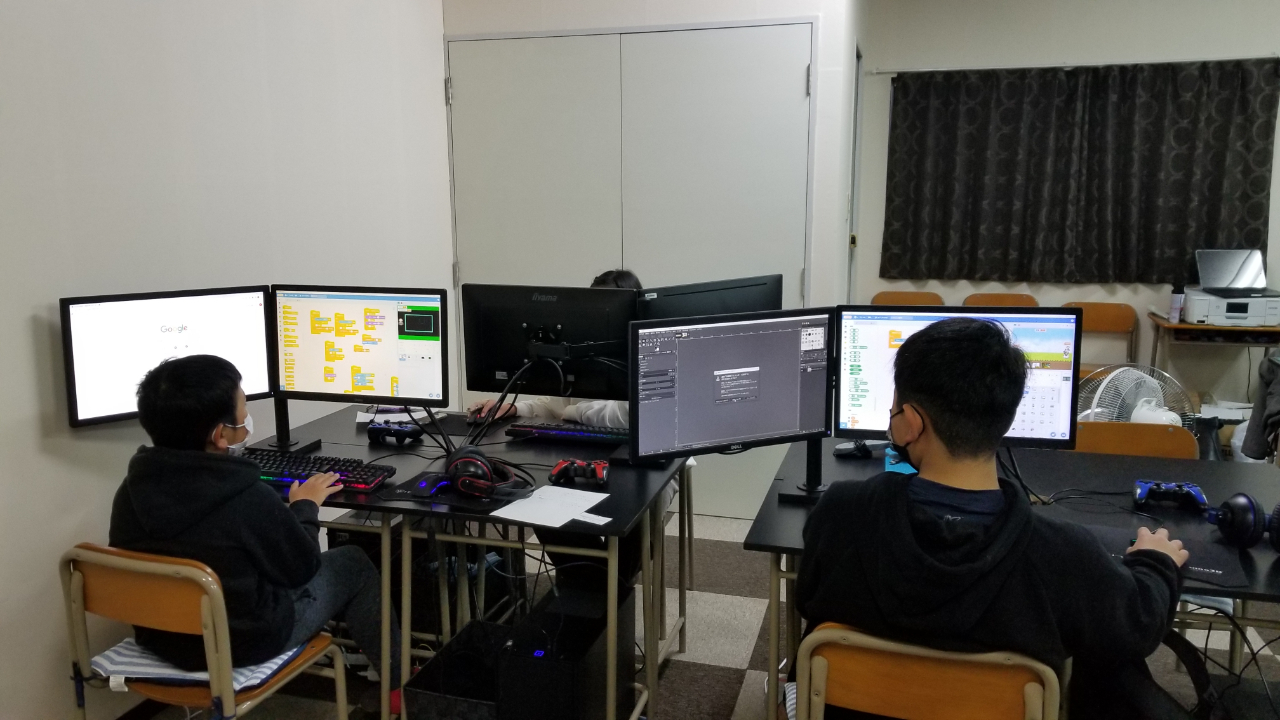
堺市南区のプログラミングスクールADVANCEで実際にプログラミングを教えている講師としての意見は以下の三つです
🎮 現場で感じる3つの変化
思考力の二極化
AIを使うことで、自分で考える力が伸びる子と、AIに頼りすぎてしまう子に分かれる傾向があります。例えば、Scratchで複雑な動きを作るとき、AIに「猫を左右に動かすコード」と聞くと、すぐに答えが出ますが、それをそのまま使ってしまうと「なぜそのコードで動くのか」という本質的な理解が深まりにくい場合があります。一方で、AIの回答を参考にしながら「もっと効率的な方法はないか」「違う動きにはどう応用できるか」と探求する子は、より深い理解と応用力を身につけます。
エラー解決の効率化と深い理解
プログラミング学習ではエラー(バグ)がつきものですが、AIがエラーの原因特定や修正案を提示してくれることで、生徒たちは効率的に学習を進められます。例えば、Pythonで書いたプログラムが動作しないとき、AIにエラーメッセージを貼り付けると、問題の箇所と修正方法を教えてくれます。これにより、「なぜこのエラーが発生したのか」という根本原因を理解する機会が増え、同じようなエラーに遭遇した際に自力で解決できる力が養われます。
創造性の促進
AIはアイデア出しや、実装のヒントを提供することで、生徒の創造性を刺激します。例えば、Unityでゲームを開発しているときに「敵キャラクターにランダムな動きをさせたい」とAIに相談すると、複数の実装方法を提案してくれます。これにより、生徒はより高度な機能やユニークなゲームアイデアを形にしやすくなり、創造的なプロジェクトに挑戦する意欲が高まります。
生成系AIはプログラミング教育において強力な支援ツールとなり得ますが、重要なのは「いかにAIを賢く使うか」というスキル、つまりAIリテラシーを育むことです。ADVANCEでは、ただ答えを教えるのではなく、AIを使って問題を解決するプロセスを通じて、子どもたちが自ら考え、学び、創造する力を引き出す指導を心がけています。
5. 保護者の方へ:家庭でできること
生成系AIツールは、プログラミング学習において大きな助けとなりますが、その利用方法によっては学習効果が大きく変わります。保護者の方が家庭でできることは以下の通りです。
AIを「先生」ではなく「アシスタント」として使うことを促す
お子さんがAIに質問する際、単に答えを求めるだけでなく、「なぜそのように考えるの?」「他にどんな方法がある?」といった批判的思考を促す問いかけをするよう指導しましょう。例えば、ChatGPTでPythonのコードを生成した際に、「このコードのどこが一番重要だと思う?」「もし〇〇を変えたらどうなるかな?」などと聞いてみることが有効です。
「試行錯誤」と「デバッグ」の経験を重視する
AIが生成したコードも完璧ではありません。お子さんには、AIのコードをそのまま使うのではなく、実際に動かしてみて、エラーが出たら自分で修正する(デバッグする)経験を積ませましょう。例えば、JavaScriptでWebページを作成している時にAIが提案したコードがうまく動かない場合、エラーメッセージを読み解き、自分で解決策を探すプロセスこそが、真のプログラミング能力を育みます。
倫理的な利用と情報源の確認を教える
AIが生成した情報やコードが、必ずしも正確とは限りません。お子さんには、AIの出力内容を鵜呑みにせず、複数の情報源で確認したり、自分で理解しようと努めることの重要性を伝えましょう。また、課題や作品制作でAIを使用する際は、その旨を明記するなど、倫理的な利用方法についても話し合うことが大切です。
🎮 ADVANCEで一緒にプログラミングを始めませんか?
堺市南区のプログラミングスクールADVANCEでは、Scratchからはじめて、Roblox、Unity(C#)まで段階的に学べます。
研究で効果が実証されたプログラミング教育を、ゲーム制作を通じて楽しく体験できます。
▶ ぼうけんを はじめる 無料体験会に申し込む!6. 参考文献
- Abouelenein, Y. A. M., Ghazala, A. F. A., Mahdy, E. M. M., & Khalaf, M. H. R. (2025). The R5E pattern: can artificial intelligence enhance programming skills development?. Education and Information Technologies, 30, 22177–22205. https://doi.org/10.1007/s10639-025-13616-3
- Akçapınar, G., & Sidan, E. (2024). AI chatbots in programming education: guiding success or encouraging plagiarism. Discover Artificial Intelligence, 4(1), 87. https://doi.org/10.1007/s44163-024-00203-7
- Alonso-García, S., Aznar-Díaz, I., Caceres-Reche, M. P., Trujillo-Torres, J. M., & Romero-Rodríguez, J. M. (2019). Systematic review of good teaching practices with ICT in Spanish Higher Education. Trends and Challenges for Sustainability. Sustainability, 11(24), 7150.
- Aromataris, E., and Pearson, A. (2014). The systematic review: an overview. AJN The American Journal of Nursing 114 (3), 53–58. https://doi.org/10.1097/01.NAJ.0000444496.24228.2c
- Aydın, N., & Erdem, O. A. (2022). A research on the new generation artificial intelligence technology generative pretraining transformer 3. In 2022 3rd International Informatics and Software Engineering Conference (IISEC) (pp. 1-6). IEEE. https://doi.org/10.1109/IISEC56263.2022.9998298
- Baidoo-Anu, D., & Ansah, L. O. (2023). Education in the era of generative artificial intelligence (AI): Understanding the potential benefits of ChatGPT in promoting teaching and learning. Journal of AI, 7(1), 52-62. https://doi.org/10.61969/jai.1337500
- Balreira, D. G., Silveira, T. L. D., & Wickboldt, J. A. (2023). Investigating the impact of adopting Python and C languages for introductory engineering programming courses. Computer Applications in Engineering Education, 31(1), 47-62. https://doi.org/10.1002/cae.22570
- Basnet, R. B., Doleck, T., Lemay, D. J., & Bazelais, P. (2018). Exploring computer science students’ continuance intentions to use Kattis. Education and Information Technologies, 23, 1145-1158. https://doi.org/10.1007/s10639-017-9658-2
- Becker, B. A., Denny, P., Finnie-Ansley, J., Luxton-Reilly, A., Prather, J., & Santos, E. A. (2023). Programming is hard—or at least it used to be: Educational opportunities and challenges of AI code generation. In Proceedings of the 54th ACM Technical Symposium on Computer Science Education V. 1 (pp. 500–506). Association for Computing Machinery. https://doi.org/10.1145/3545945.3569759
- Bennedsen, J., & Caspersen, M. E. (2007). Failure rates in introductory programming. ACM SIGCSE Bulletin, 39(2), 32-36. https://doi.org/10.1145/1272848.1272879
- Bien, J., & Mukherjee, G. (2025). Generative AI for data science 101: Coding without learning to code. Journal of Statistics and Data Science Education, 33(2), 129-142. https://doi.org/10.1080/26939169.2024.2432397
- Brown, T. B., Mann, B., Ryder, N., Subbiah, M., Kaplan, J. D., Dhariwal, P., Neelakantan, A., Shyam, P., Sastry, G., Askell, A., Agarwal, S., Herbert‑Voss, A., Krueger, G., Henighan, T., Child, R., Ramesh, A., Ziegler, D. M., Wu, J., Winter, C., Hesse, C., Chen, M., Sigler, E., Litwin, M., Gray, S., Chess, B., Clark, J., Berner, C., McCandlish, S., Radford, A., Sutskever, I., & Amodei, D. (2020). In Proceedings of the 34th International Conference on Neural Information Processing Systems (NIPS '20). Curran Associates Inc.
- Cao, C. (2023). Scaffolding CS1 courses with a large language model-powered intelligent tutoring system. In Companion Proceedings of the 28th International Conference on Intelligent User Interfaces (pp. 229-232). Association for Computing Machinery. https://doi.org/10.1145/3581754.3584111
- Casillas-Martín, S., Cabezas-González, M., & García-Valcárcel Muñoz-Repiso, A. (2020). DigiCraft: A pedagogical innovative proposal for the development of the digital competence in vulnerable children. Sustainability, 12(23), 9865. https://doi.org/10.3390/su12239865
- Chen, E., Huang, R., Chen, H.-S., Tseng, Y.-H., & Li, L.-Y. (2023). GPTutor: A ChatGPT-powered programming tool for code explanation. In N. Wang, G. Rebolledo-Mendez, V. Dimitrova, N. Matsuda, & O. C. Santos (Eds.), Artificial Intelligence in Education (Vol. 1831, pp. 321–327). Springer. https://doi.org/10.1007/978-3-031-36336-8_50
- Coto, M., Mora, S., Grass, B., & Murillo-Morera, J. (2022). Emotions and programming learning: systematic mapping. Computer Science Education, 32(1), 30-65. https://doi.org/10.1080/08993408.2021.1920816
- Creswell, J. W. (2012). Educational research: Planning, conducting, and evaluating quantitative and qualitative research. 4th ed.; Pearson. Merrill Prentice Hall, Singapore
- Denny, P., Becker, B. A., Leinonen, J., & Prather, J. (2023). Chat overflow: Artificially intelligent models for computing education-renAIssance or apocAIypse?. In Proceedings of the 2023 Conference on Innovation and Technology in Computer Science Education V. 1 (ITiCSE 2023) (pp. 3–4). Association for Computing Machinery. https://doi.org/10.1145/3587102.3588773
- Denny, P., MacNeil, S., Savelka, J., Porter, L., & Luxton-Reilly, A. (2024b). Desirable characteristics for AI teaching assistants in programming education. In Proceedings of the 2024 on Innovation and Technology in Computer Science Education V. 1 (ITiCSE 2024). (pp. 408-414). Association for Computing Machinery. https://doi.org/10.1145/3649217.3653574
- Denny, P., Prather, J., Becker, B. A., Finnie-Ansley, J., Hellas, A., Leinonen, J., & Sarsa, S. (2024a). Computing education in the era of generative AI. Communications of the ACM, 67(2), 56-67. https://doi.org/10.1145/3624720
- Dos Santos, O. L., & Cury, D. (2023). Challenging the confirmation bias: Using ChatGPT as a virtual peer for peer instruction in computer programming education. In 2023 IEEE Frontiers in Education Conference (FIE) (pp. 1–7). IEEE. https://doi.org/10.1109/FIE58773.2023.10343247
- Fangohr, H. (2004). A comparison of C, MATLAB, and Python as teaching languages in engineering. In M. Bubak, G. D. van Albada, P. M. A. Sloot, & J. Dongarra (Eds.), Computational science – ICCS 2004 (Vol. 3039, pp. 1210–1217). Springer. https://doi.org/10.1007/978-3-540-25944-2_157
- Feng, Y., Vanam, S., Cherukupally, M., Zheng, W., Qiu, M., & Chen, H. (2023). Investigating code generation performance of ChatGPT with crowdsourcing social data. In 2023 IEEE 47th Annual Computers, Software, and Applications Conference (COMPSAC) (pp. 876–885). IEEE. https://doi.org/10.1109/COMPSAC57700.2023.00117
- Fenu, G., Galici, R., Marras, M., & Reforgiato, D. (2024). Exploring student interactions with AI in programming training. In Adjunct Proceedings of the 32nd ACM Conference on User Modeling, Adaptation and Personalization (UMAP Adjunct '24). (pp. 555-560). https://doi.org/10.1145/3631700.3665227
- Finnie-Ansley, J., Denny, P., Becker, B. A., Luxton-Reilly, A., & Prather, J. (2022). The robots are coming: Exploring the implications of OpenAI Codex on introductory programming. In Proceedings of the 24th Australasian Computing Education Conference (pp. 10–19). Association for Computing Machinery. https://doi.org/10.1145/3511861.3511863
- Finnie-Ansley, J., Denny, P., Luxton-Reilly, A., Santos, E. A., Prather, J., & Becker, B. A. (2023). My AI wants to know if this will be on the exam: Testing OpenAI’s Codex on CS2 programming exercises. In Proceedings of the 25th Australasian Computing Education Conference (pp. 97–104). Association for Computing Machinery. https://doi.org/10.1145/3576123.3576134
- Gamage, S. H., Ayres, J. R., & Behrend, M. B. (2022). A systematic review on trends in using Moodle for teaching and learning. International journal of STEM education, 9(1), 1–24. https://doi.org/10.1186/s40594-021-00323-x
- Geng, C., Zhang, Y., Pientka, B., & Si, X. (2023). Can ChatGPT pass an introductory level functional language programming course?. arXiv preprint arXiv:2305.02230. https://doi.org/10.48550/arXiv.2305.02230
- Gezgin, D. M., Mert, S., Kesici, A. İ., Yıldırım, S. (2024). Understanding University Students’ Intentions to Use Chatbots in Computer Programming Education: A Quantitative Study. Sakarya University Journal of Education, 14(Special Issue-AI in Education), 142-158. https://doi.org/10.19126/suje.1426980
- Haindl, P., & Weinberger, G. (2024). Does ChatGPT help novice programmers write better code? Results from static code analysis. IEEE Access vol. 12. (pp. 114146-114156). https://doi.org/10.1109/ACCESS.2024.3445432
- Huang, L., Zhang, H., Li, R., Ge, Y., & Wang, J. (2020). AI coding: Learning to construct error correction codes. IEEE Transactions on Communications, 68(1), 26–39. https://doi.org/10.1109/TCOMM.2019.2951403
- Israilidis, J., Chen, W.-Y., & Tsakalerou, M. (2024). Software development and education: Transitioning towards AI enhanced teaching. In 2024 IEEE Global Engineering Education Conference (EDUCON) (pp. 1–6). IEEE. https://doi.org/10.1109/EDUCON60312.2024.10578564
- Jing, Y., Wang, H., Chen, X., & Wang, C. (2024). What factors will affect the effectiveness of using ChatGPT to solve programming problems? A quasi-experimental study. Humanities and Social Sciences Communications, 11(319), 1-12. https://doi.org/10.1057/s41599-024-02751-w
- Jonsson, M., & Tholander, J. (2022). Cracking the code: Co-coding with AI in creative programming education. In Proceedings of the 14th Conference on Creativity and Cognition (pp. 5–14). Association for Computing Machinery. https://doi.org/10.1145/3527927.3532801
- Jošt, G., Taneski, V., & Karakatič, S. (2024). The impact of large language models on programming education and student learning outcomes. Applied Sciences, 14(10), 4115. https://doi.org/10.3390/app14104115
- Jury, B., Lorusso, A., Leinonen, J., Denny, P., & Luxton-Reilly, A. (2024). Evaluating LLM-generated worked examples in an introductory programming course. In Proceedings of the 26th Australasian Computing Education Conference (pp. 77–86). Association for Computing Machinery. https://doi.org/10.1145/3636243.3636252
- Karanjai, R., Li, E., Xu, L., & Shi, W. (2023). Who is smarter? An empirical study of AI-based smart contract creation. In 2023 5th Conference on Blockchain Research & Applications for Innovative Networks and Services (BRAINS) (pp. 1–8). IEEE. https://doi.org/10.1109/BRAINS59668.2023.10316829
- Kazemitabaar, M., Chow, J., Ma, C. K. T., Ericson, B. J., Weintrop, D., & Grossman, T. (2023). Studying the effect of AI code generators on supporting novice learners in introductory programming. In Proceedings of the 2023 CHI Conference on Human Factors in Computing Systems (pp. 1–23). Association for Computing Machinery. https://doi.org/10.1145/3544548.3580919
- Keuning, H., Jeuring, J., & Heeren, B. (2018). A systematic literature review of automated feedback generation for programming exercises. ACM Transactions on Computing Education (TOCE), 19(1), 1-43. https://doi.org/10.1145/3231711
- Kiesler, N., & Schiffner, D. (2023). Large language models in introductory programming education: ChatGPT's performance and implications for assessments. In CoRR abs/2308.08572. https://doi.org/10.48550/arXiv.2308.08572
- Kosar, T., Ostojić, D., Liu, Y. D., & Mernik, M. (2024). Computer science education in ChatGPT era: Experiences from an experiment in a programming course for novice programmers. Mathematics, 12(5), 629. https://doi.org/10.3390/math12050629
- Kwok, Y. H., & Wong, K. P. (2023). A pilot study of using ChatGPT as a teaching tool for software engineering education. In 16th International Symposium on Advances in Technology Education (ISATE 2023). 12-15 September 2023. Matsue, Japan.
- Leinonen, J., Denny, P., MacNeil, S., Sarsa, S., Bernstein, S., Kim, J., Tran, A., & Hellas, A. (2023). Comparing code explanations created by students and large language models. In Proceedings of the 2023 Conference on Innovation and Technology in Computer Science Education V. 1 (pp. 124–130). Association for Computing Machinery. https://doi.org/10.1145/3587102.3588785
- Liffiton, M., Sheese, B. E., Savelka, J., & Denny, P. (2024). CodeHelp: Using large language models with guardrails for scalable support in programming classes. In Proceedings of the 23rd Koli Calling International Conference on Computing Education Research (pp. 1–11). Association for Computing Machinery. https://doi.org/10.1145/3631802.3631830
- Logacheva, E., Hellas, A., Prather, J., Sarsa, S., & Leinonen, J. (2024). Evaluating contextually personalized programming exercises created with generative AI. In Proceedings of the 2024 ACM Conference on International Computing Education Research - Volume 1 (pp. 95–113). Association for Computing Machinery. https://doi.org/10.1145/3632620.3671103
- Lyu, W., Wang, Y., Chung, T. R., Sun, Y., & Zhang, Y. (2024). Evaluating the effectiveness of LLMs in introductory computer science education: A semester-long field study. In Proceedings of the Eleventh ACM Conference on Learning @ Scale (pp. 63–74). Association for Computing Machinery. https://doi.org/10.1145/3657604.3662036
- Ma, B., Chen, L., & Konomi, S. (2024). Enhancing programming education with ChatGPT: A case study on student perceptions and interactions in a Python course. In A. M. Olney, I.-A. Chounta, Z. Liu, O. C. Santos, & I. I. Bittencourt (Eds.), Artificial intelligence in education (Vol. 2150, pp. 110–116). Springer. https://doi.org/10.1007/978-3-031-64315-6_9
- MacNeil, S., Tran, A., Hellas, A., Kim, J., Sarsa, S., Denny, P., Bernstein, S., & Leinonen, J. (2023). Experiences from using code explanations generated by large language models in a web software development e-book. In Proceedings of the 54th ACM Technical Symposium on Computer Science Education V. 1 (pp. 931–937). Association for Computing Machinery. https://doi.org/10.1145/3545945.3569785
- Meline, T. (2006). Selecting studies for systemic review: Inclusion and exclusion criteria. Contemporary issues in communication science and disorders, 33(Spring), 21-27. https://doi.org/10.1044/cicsd_33_S_21
- Miles, M. B., Huberman, A. M. (1994). Qualitative data analysis: An expanded sourcebook. Sage.
- Muldner, K., Jennings, J., & Chiarelli, V. (2023). A review of worked examples in programming activities. ACM Transactions on Computing Education, 23(1), Article 13. https://doi.org/10.1145/3560266
- Page, M. J., Moher, D., Bossuyt, P. M., Boutron, I., Hoffmann, T. C., Mulrow, C. D., & McKenzie, J. E. (2021). PRISMA 2020 explanation and elaboration: updated guidance and exemplars for reporting systematic reviews. British Medical Journal, 372. https://doi.org/10.1136/bmj.n160
- Pankiewicz, M., & Baker, R. S. (2024). Navigating compiler errors with AI assistance: A study of GPT hints in an introductory programming course. In Proceedings of the 2024 on Innovation and Technology in Computer Science Education V. 1 (pp. 94–100). Association for Computing Machinery. https://doi.org/10.1145/3649217.3653608
- Park, A., & Kim, T. (2025). Code suggestions and explanations in programming learning: Use of ChatGPT and performance. The International Journal of Management Education, 23(2), 101119. https://doi.org/10.1016/j.ijme.2024.101119
- Peng, S., Kalliamvakou, E., Cihon, P., & Demirer, M. (2023). The impact of AI on developer productivity: Evidence from GitHub Copilot. https://doi.org/10.48550/arXiv.2302.06590
- Prather, J., Reeves, B. N., Leinonen, J., MacNeil, S., Randrianasolo, A. S., Becker, B. A., Kimmel, B., Wright, J., & Briggs, B. (2024). The widening gap: The benefits and harms of generative AI for novice programmers. In Proceedings of the 2024 ACM Conference on International Computing Education Research - Volume 1 (pp. 469–486). Association for Computing Machinery. https://doi.org/10.1145/3632620.3671116
- Qureshi, B. (2023). ChatGPT in computer science curriculum assessment: An analysis of its successes and shortcomings. In Proceedings of the 2023 9th International Conference on e-Society, e-Learning and e-Technologies (pp. 7–13). Association for Computing Machinery. https://doi.org/10.1145/3613944.3613946
- Reeves, B., Sarsa, S., Prather, J., Denny, P., Becker, B. A., Hellas, A., Kimmel, B., Powell, G., & Leinonen, J. (2023). Evaluating the performance of code generation models for solving Parsons problems with small prompt variations. In Proceedings of the 2023 Conference on Innovation and Technology in Computer Science Education V. 1 (pp. 299–305). Association for Computing Machinery. https://doi.org/10.1145/3587102.3588805
- Rocha, A., Sousa, L., Alves, M., & Sousa, A. (2024). The underlying potential of NLP for microcontroller programming education. Computer Applications in Engineering Education, e22778. https://doi.org/10.1002/cae.22778
- Roest, L., Keuning, H., & Jeuring, J. (2024). Next-step hint generation for introductory programming using large language models. In Proceedings of the 26th Australasian Computing Education Conference (pp. 144–153). Association for Computing Machinery. https://doi.org/10.1145/3636243.3636259
- Sharma, P., & Harkishan, M. (2022). Designing an intelligent tutoring system for computer programing in the Pacific. Education and Information Technologies, 27(5), 6197-6209. https://doi.org/10.1007/s10639-021-10882-9
- Sheese, B., Liffiton, M., Savelka, J., & Denny, P. (2024). Patterns of student help-seeking when using a large language model-powered programming assistant. In Proceedings of the 26th Australasian Computing Education Conference (pp. 49–57). Association for Computing Machinery. https://doi.org/10.1145/3636243.3636249
- Suh, J., Lee, K., & Lee, J. (2025). Programming education with ChatGPT: outcomes for beginners and intermediate students. Education and Information Technologies, 1-26. https://doi.org/10.1007/s10639-025-13542-4
- Sun, D., Boudouaia, A., Zhu, C., & Li, Y. (2024). Would ChatGPT-facilitated programming mode impact college students’ programming behaviors, performances, and perceptions? An empirical study. International Journal of Educational Technology in Higher Education, 21(1), 14. https://doi.org/10.1186/s41239-024-00446-5
- Surameery, N. M. S., & Shakor, M. Y. (2023). Use Chat GPT to solve programming bugs. International Journal of Information Technology and Computer Engineering, (31), 17-22. https://doi.org/10.55529/ijitc.31.17.22
- Susilo, M. J., Sulisworo, D., & Beungacha, S. (2023). Technology and its impact on education. Buletin Edukasi Indonesia, 2(02), 47-54.
- Tian, H., Lu, W., Li, T. O., Tang, X., Cheung, S. C., Klein, J., & Bissyandé, T. F. (2023). Is ChatGPT the ultimate programming assistant--how far is it? https://doi.org/10.48550/arXiv.2304.11938
- Tricco, A. C., Straus, S. E., & Moher, D. (2011). How can we improve the interpretation of systematic reviews?. BMC medicine, 9, 1-4. https://doi.org/10.1186/1741-7015-9-31
- von Hausswolff, K., Eckerdal, A., & Thuné, M. (2020). Learning to program hands-on: A controlled study. In Proceedings of the 20th Koli Calling International Conference on Computing Education Research (Article 6, pp. 1–10). Association for Computing Machinery. https://doi.org/10.1145/3428029.3428058
- Yang, A. C., Lin, J. Y., Lin, C. Y., & Ogata, H. (2024). Enhancing python learning with PyTutor: Efficacy of a ChatGPT-Based intelligent tutoring system in programming education. Computers and Education: Artificial Intelligence, 7, 100309. https://doi.org/10.1016/j.caeai.2024.100309
- Yang, T. C., Hsu, Y. C., & Wu, J. Y. (2025). The effectiveness of ChatGPT in assisting high school students in programming learning: evidence from a quasi-experimental research. Interactive Learning Environments, 1-18. https://doi.org/10.1080/10494820.2025.2450659
- Yilmaz, R., & Karaoglan-Yilmaz, F. G. (2023a). Augmented intelligence in programming learning: Examining student views on the use of ChatGPT for programming learning. Computers in Human Behavior: Artificial Humans, 1(2), 100005. https://doi.org/10.1016/j.chbah.2023.100005
- Yilmaz, R., & Karaoglan-Yilmaz, F. G. (2023b). The effect of generative artificial intelligence (AI)-based tool use on students' computational thinking skills, programming self-efficacy and motivation. Computers and Education: Artificial Intelligence, 4, 100147. https://doi.org/10.1016/j.caeai.2023.100147